Water Remediation
North Texas
Texas Fast Restoration provides IICRC-certified water remediation across the DFW Metroplex — addressing contamination, structural moisture, and microbial risk after any water loss. 24/7 emergency response.
What Is Water Remediation — And How It's Different From Restoration
Water remediation and water restoration are often used interchangeably, but they describe two different parts of the recovery process. Remediation refers specifically to removing contaminated water and addressing the health and safety risks left behind — bacteria, mold spores, and microbial growth. Restoration refers to repairing and rebuilding the physical structure once it's safe and dry.
Texas Fast Restoration handles both phases under one roof, but understanding the distinction matters when you're choosing a contractor or working with your insurance adjuster. Remediation work is governed by IICRC S500 (water damage) and S520 (mold) standards, which dictate water categorization, drying protocols, and microbial risk assessment — not just "drying out" a space.
Water is classified into three categories based on contamination level: Category 1 (clean water from a supply line), Category 2 (gray water with some contaminants, like washing machine overflow), and Category 3 (black water — sewage, flooding, or water that has been standing long enough to support bacterial growth). Each category requires a different remediation protocol, and misclassifying water contamination is one of the most common — and costly — mistakes in this industry.
How Water Remediation Works
A systematic, standards-based process from first call to final clearance.
Water Categorization & Assessment
Every job starts with proper classification of water contamination level (Category 1, 2, or 3) and an assessment of how far moisture has traveled into walls, subfloors, and structural materials using thermal imaging and moisture meters.
Containment & Extraction
For Category 2 or 3 water, we establish containment to prevent cross-contamination to unaffected areas. Industrial extraction equipment removes standing water immediately to limit material saturation time.
Antimicrobial Treatment
Affected surfaces are treated with EPA-registered antimicrobial agents to address bacteria and inhibit mold growth — a required step under IICRC S500 for any water above Category 1.
Structural Drying & Monitoring
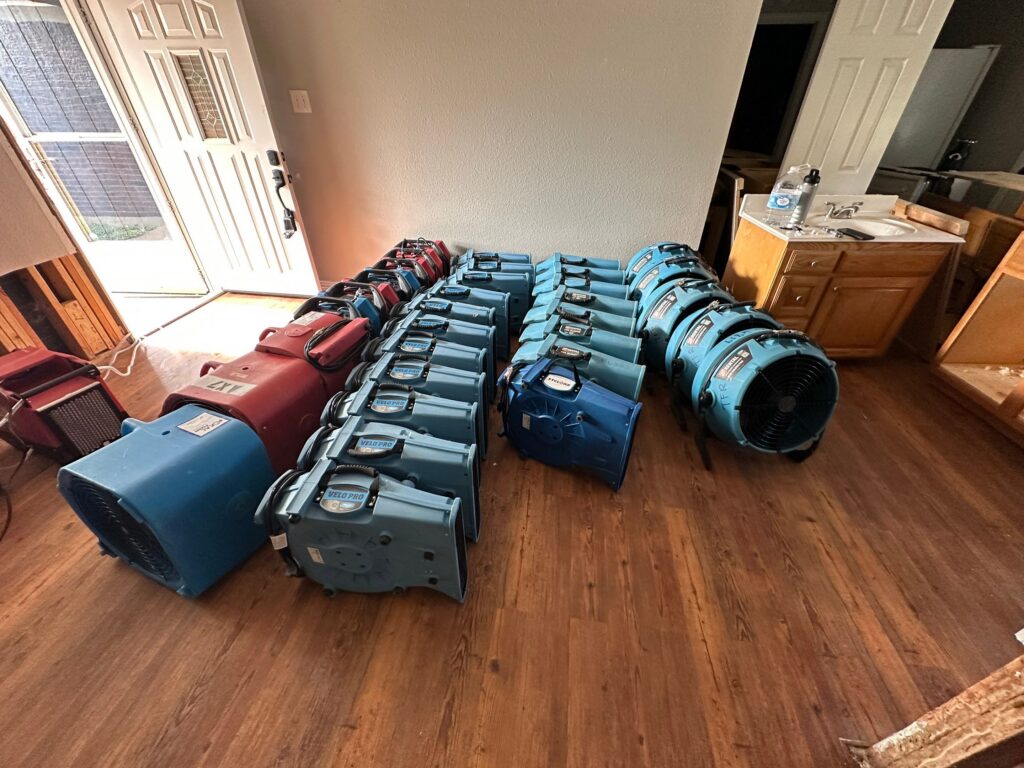
Commercial-grade air movers and LGR dehumidifiers are deployed based on a calculated drying plan. We monitor moisture content daily with documented readings until materials reach pre-loss dry standard.
Clearance Testing & Documentation
Before closing any job, we verify drying is complete and provide full documentation — moisture logs, photos, and scope of work — for your insurance claim and your own records.
The Right Team for Water Remediation
IICRC-certified, locally based, and available around the clock across the full DFW Metroplex.
IICRC S500 & S520 certified
Trained to the actual industry standard, not informal drying methods
Proper water categorization on every job
Misclassifying contamination level is the most common industry mistake
EPA-registered antimicrobial treatment
Standard on every Category 2 and 3 job — not an upsell
Full DFW Metroplex coverage
Trophy Club to Dallas to Fort Worth — one phone call
Insurance documentation built in
Moisture logs and photo evidence that hold up with adjusters
24/7 dispatch, no call center
Local team answers directly, every time
Common Questions About Water Remediation
Straight answers to what North Texas homeowners ask most.
Water Remediation Across North Texas
Texas Fast Restoration provides water remediation in every major North Texas community. Click your city for local details.
Need Water Remediation Now?
Every hour of delay increases damage, contamination risk, and restoration cost. Our team is standing by 24/7.
817-422-7236